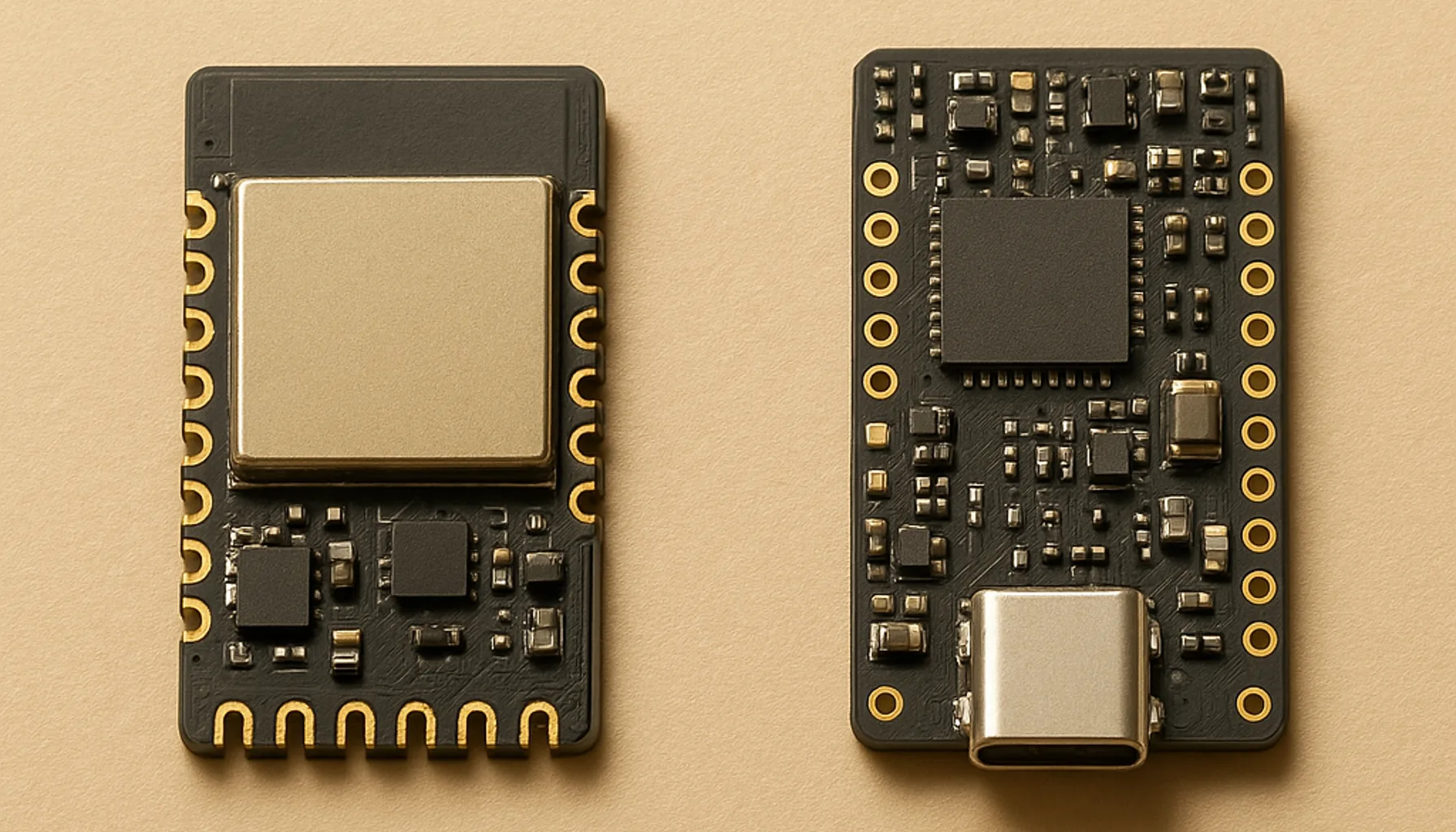
Short answer: for a Home Assistant project in 2026, buy an ESP32-class board — the ESP32-C6 DevKit is the best value in our ESP32 board guide. The ESP8266 is not dead, and anyone who tells you it’s useless is overcorrecting: for one dumb €3 Wi-Fi relay it is still the right tool. But as the default for smart-home hardware it fails — too little RAM and flash for comfortable TLS and OTA, no Bluetooth, no secure boot, no Thread/Zigbee radio.
To keep this honest: this comparison is research-based, from Espressif’s documentation [1], a March 2026 head-to-head that went through the numbers [2], ESPHome’s platform docs [3] and Wikipedia’s hardware entries [4]. We did not A/B-test every board in a lab, and you should not trust anyone who claims they did with €3 hardware.
The claim
“ESP8266 is all you need” was the tutorial advice of 2016–2020 — and it made sense then. Boards cost €2–4, Zigbee2MQTT did not exist, ESPHome was a newborn, and a smart plug was a luxury. Ten years later the advice is still the most-clicked answer on the topic, but the ecosystem moved on: TLS is the default for MQTT, devices get updated over the air, and cheap boards now carry radios the 8266 never dreamed of. The gap between the advice and the hardware is the subject of this guide.
What the ESP8266 actually is
The ESP8266 is an 80 MHz single-core chip (Tensilica L106 class, overclockable to ~160 MHz) with RAM measured in the low hundreds of kilobytes and typically 1–4 MB of flash [2] [4]. It has one radio: 2.4 GHz Wi-Fi 4. No Bluetooth. No 802.15.4. No secure boot. On paper it is a “Wi-Fi-to-serial converter that grew a dev ecosystem” — and that description is more accurate than most product pages.
The good: it still ships, it costs €3, the tutorial base is enormous, and for “make this dumb appliance talk to my network and never touch it again” it is genuinely fine.
What the ESP32 family brings
| ESP32 classic | ESP32-S3 | ESP32-C6 | |
|---|---|---|---|
| Chip | Xtensa dual-core, 240 MHz | Xtensa, 160 MHz | RISC-V, 160 MHz |
| Wi-Fi | 4 (b/g/n) | 4 (b/g/n) | 6 (ax) |
| Bluetooth | 4.2 | 5.0 LE + Mesh | 5.0 LE + Mesh |
| 802.15.4 | – | – | Thread + Zigbee 3.0 |
| Flash | 4 MB | 4 MB | 8 MB (N8) |
| Host port | micro-USB | varies | USB-C (USB + UART) |
| Secure boot | – | ✓ | ✓ |
Every one of these runs ESPHome with over-the-air updates [3]. None of them is expensive — the C6 DevKit we recommend sits around €15, the classic around €10.
Where the ESP8266 still wins
- Price. Four 8266 boards for the price of one ESP32-C6. If you need dozens of dead-simple Wi-Fi relays, that math is real.
- One-off hacks. A project you flash once and never update: a lamp switch, a garage-door dry contact, a temperature readout. The 8266 does not punish you for leaving it alone.
- Footprint and power. The D1 mini class is tiny and sips power — handy inside cramped wall boxes.
- If the project will never do TLS, never speak Bluetooth and never hold more than a few KB of state.
Where it falls apart in a smart home
- TLS. MQTT over TLS is the Home Assistant default for good reason. RSA-2048 handshakes plus a handful of kilobytes of RAM is where 8266 projects start hurting — long connects, dropped sessions, fiddly certificate handling.
- OTA. A small flash leaves little headroom for encrypted, signed updates. And once a smart home is older than a week, you will want to update devices.
- No Bluetooth. No BLE proxy, no reading cheap Xiaomi/beacon sensors, no acting as a BLE bridge. ESP32 boards do all of that in one evening.
- No 802.15.4. No Thread, no Zigbee experiments — while the C6 includes that radio on the same board as Wi-Fi.
- No secure boot. You flash a device and have no way to verify what is actually running on it.
- The €3 math is backwards. In a system that grows, the hours spent reflashing or replacing outgrown 8266s dwarf the euros saved at purchase time. We know exactly one of these arguments from our own 46-device network: uniformity beats bargain-hunting once the second shelf of gadgets appears.
The ESPHome reality check
“ESPHome supports both” is true and not helpful — support is not the differentiator. What decides is which ESPHome features you lean on. For simple switches, contact sensors and LED strips, the 8266 remains sufficient [3]. For displays, BLE gateways, TLS-heavy integrations, larger OTA payloads and any experiment with radios, the ESP32 line is where ESPHome’s modern features and new silicon land. Buying an 8266 today for a future-proof smart home means betting the decade-old chip stays enough — a bet you can make, but you should know you’re making it.
The verdict
- Standard Home Assistant gadget or anything that might grow → buy the ESP32-C6 DevKit (see our board guide).
- One-off €3 relay that never changes → buy the ESP8266, with zero guilt.
- Both answers are defensible. What stopped being defensible is defaulting to the decade-old chip.
Sources: [1] Espressif — “ESP32-C6” product documentation (espressif.com); [2] PCBSync — “ESP8266 vs ESP32: Which WiFi Module Should You Choose?” (2026-03-04); [3] ESPHome — platform & getting started documentation (esphome.io); [4] Wikipedia — “ESP8266” and “ESP32” (hardware specifications).
Prices and availability checked on 2026-09-30. We earn commissions from qualifying purchases — see our affiliate disclosure.