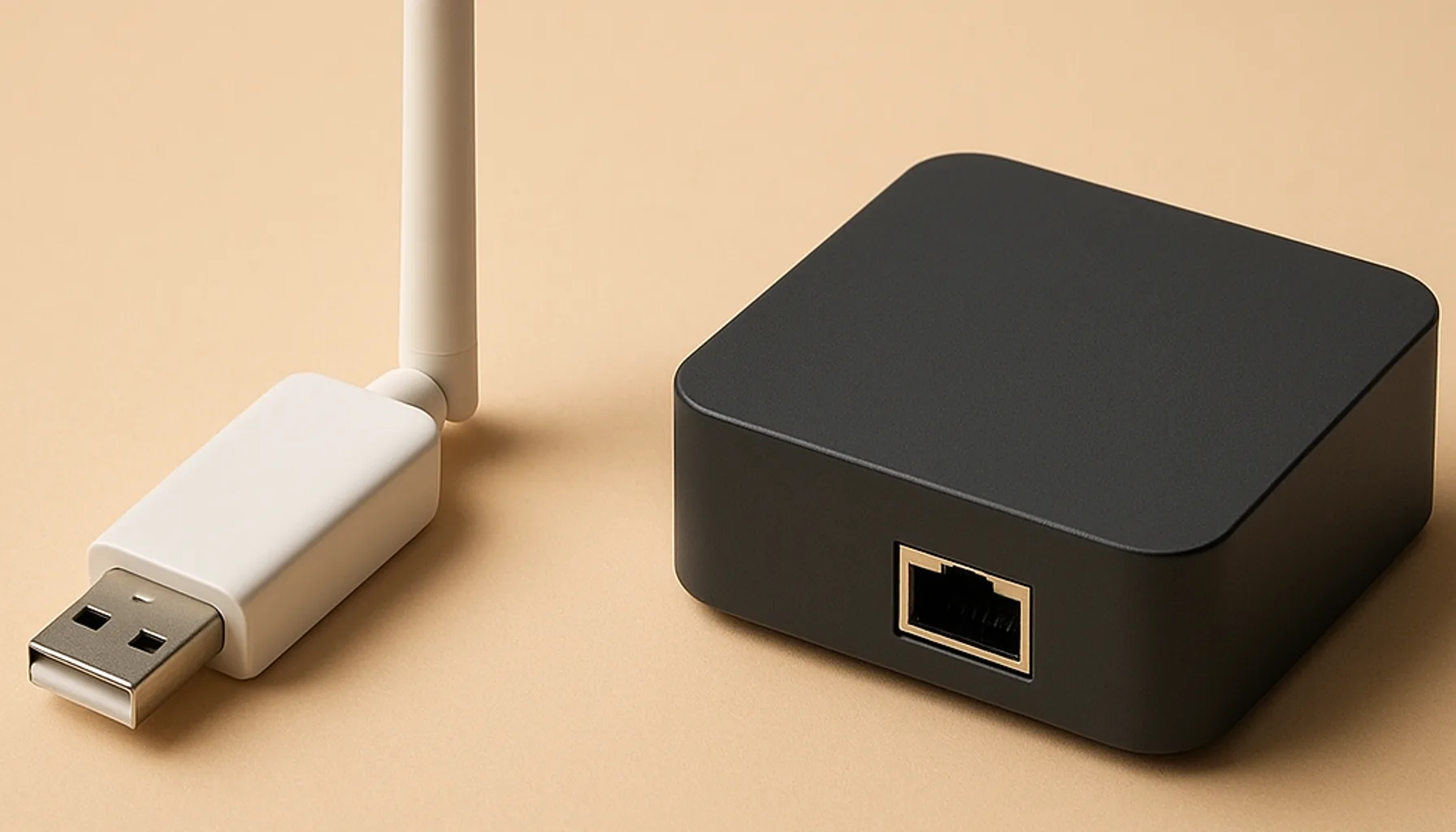
Short answer: For Home Assistant in 2026, the best “Zigbee hub” is not a hub at all — it’s the Sonoff ZBDongle-E plus a 1 m USB 2.0 extension cable. It’s the coordinator our 46-device network runs on: cheap, local, open, and boring in the best way. Choose the SMLIGHT SLZB-06 only when the radio has to live away from your server.
If you came from SmartThings, Hubitat or an Aqara hub, this guide is for you — I went down the same rabbit hole, and the exit is a €25 USB stick.
What we run
One ZBDongle-E (EFR32MG21 radio) plugged into our Home Assistant box via a 1 m USB 2.0 extension cable, running Zigbee2MQTT, coordinating 46 devices across the house. It survived a full coordinator migration without re-pairing a single device, and it’s the one component I have never had to think about since.
That’s the honest pitch, and it’s also the limit of my “hub” testing: everything about branded hubs in this guide is based on how they work architecturally — not on me running SmartThings for six months. I’ll be clear where each claim comes from.
What people actually mean by “Zigbee hub”
Before you buy anything, untangle the word “hub”. It means three different things, and only one of them is what you want:
| They call it… | What it actually is | Good for |
|---|---|---|
| “Hub” (SmartThings, Hubitat, Aqara) | A closed controller with its own app and cloud | Non-HA users who want an app |
| “Coordinator / stick” (ZBDongle-E) | A raw Zigbee radio plugged into your HA server | Home Assistant / Zigbee2MQTT / ZHA |
| “Network coordinator” (SLZB-06) | A standalone radio on Ethernet/PoE, still local | HA users who need distance from the server |
The trap: “best zigbee hub” search results mostly show closed ecosystems. If you run Home Assistant, you don’t want another brain in the house — you want a radio your server can talk to directly. That’s a coordinator.
Why a USB stick beats a branded hub
I’ll skip the spec-sheet fight and give you the architectural reasons:
- One brain per home. Home Assistant is your hub. Adding a SmartThings-style hub means two systems, two apps, two sources of truth — and automations that break when they disagree.
- Locality. A coordinator is a dumb pipe: everything happens on your server, local, no cloud, no account. Branded hubs route (at least some) traffic through their cloud and can kill your automations when the service changes.
- Protocol fit. Zigbee “hubs” are usually locked to their vendor’s device catalog. A coordinator with Zigbee2MQTT or ZHA pairs with anything that speaks Zigbee 3.0 — Aqara, SONOFF, IKEA, you name it.
- Price. A proper stick costs €20–27. “Hubs” cost €100+ and take a USB port anyway for HA setups.
The counter-case for a branded hub is simple: you don’t run Home Assistant and never will. Different project, different tool.
Our pick: the ZBDongle-E
The ZBDongle-E wins for the same reasons it wins in our coordinator shortlist:
- The community is the safety net. Most Zigbee2MQTT docs assume you own one; the failure modes are documented, the firmware is web-flashable and updated.
- It pairs with anything. Aqara, IKEA TRETAFT, SONOFF — on our network it has never met a device it couldn’t pair.
- The extension-cable habit fixes the real problem. USB 3.0 ports radiate interference on 2.4 GHz; 1–2 m of USB 2.0 cable away from the box is the single most documented reliability fix in Zigbee, and it costs a few euros.
Don’t overthink the “hub” question: this is the boring, correct answer for nine out of ten Home Assistant setups.
When Ethernet makes sense: the SLZB-06
If your server lives in a rack or closet and the mesh needs the coordinator in the hallway or garage, a USB stick at the server is the wrong seat. That’s the case for the SLZB-06: Ethernet/PoE, powered, and placed where the network actually needs it. We covered the full head-to-head in USB vs Ethernet/PoE.
Two honest notes: we don’t run the SLZB-06 24/7 ourselves — that recommendation comes from the architecture and community experience, not our own rack. And it fixes placement, not a thin mesh: if devices drop because you lack mains-powered routers, no coordinator saves you (that’s a range problem).
Honest caveats
- “Hub” buyers are often brand-hunting. If you specifically want the SmartThings/Aqara ecosystems, this guide isn’t arguing you out of them — it’s answering “which hub for Home Assistant”, and that answer is a coordinator.
- USB passthrough on VMs is a moving part. If you’re on Proxmox, a network coordinator removes USB-from-under-the-server entirely.
- We haven’t lab-tested every stick. We pick the ZBDongle-E for its ecosystem, its price, and 24/7 use on a real 46-device network — not because we bench-tested ten alternatives.
Bottom line
The best Zigbee hub for Home Assistant in 2026 is the ZBDongle-E plus a USB 2.0 extension cable — local, open, €25, and backed by the largest community in the ecosystem. Buy the SLZB-06 when placement demands Ethernet. Skip the branded “hubs” unless you’re skipping Home Assistant too.
Prices and availability checked 2026-09-28. Commissions are earned from qualifying purchases — see our affiliate disclosure.