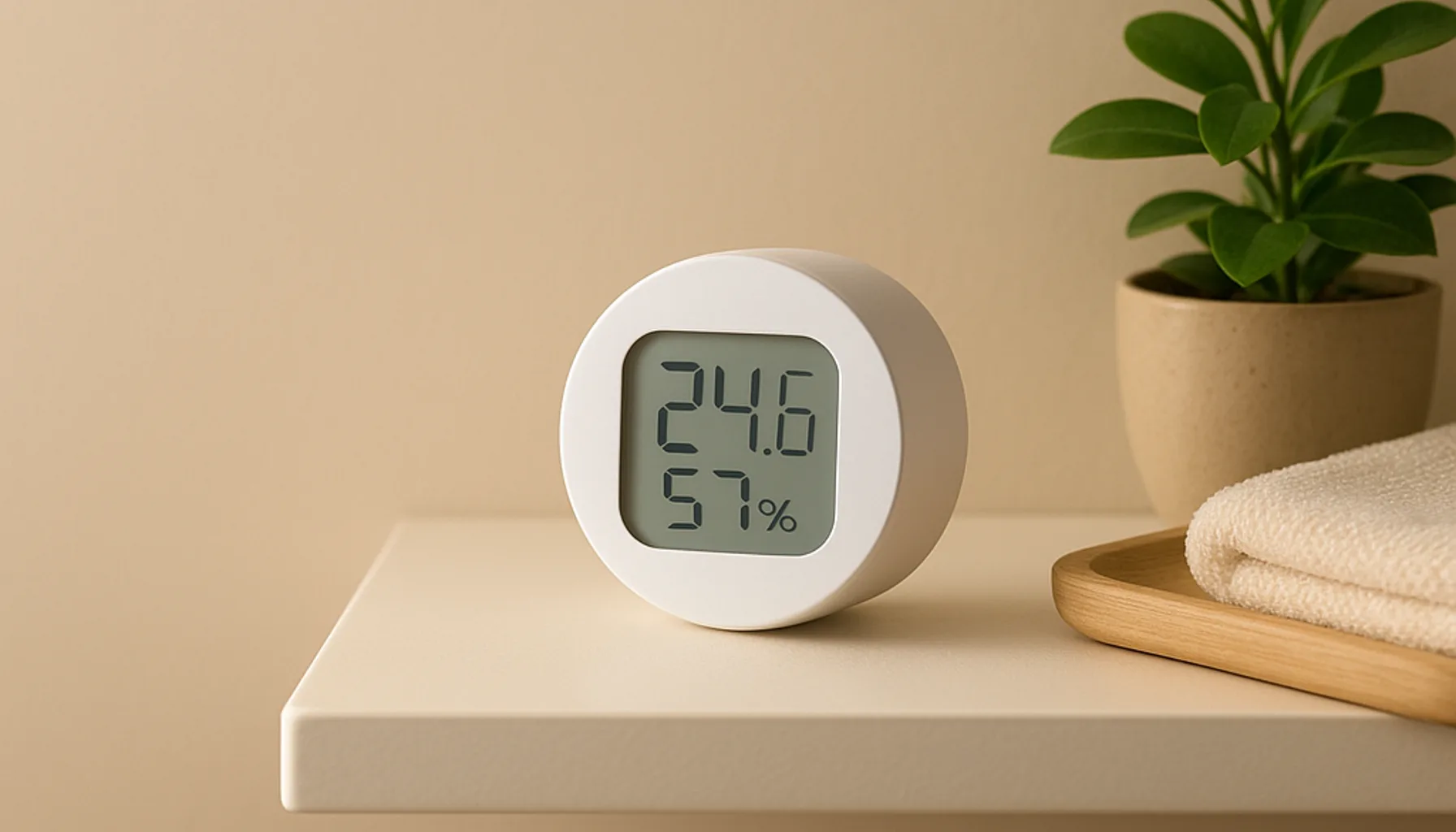
Short answer: Buy the Sonoff SNZB-02D. It’s the only humidity-reporting sensor we run and trust: official ±2% RH accuracy, a display, Zigbee 3.0, and full Zigbee2MQTT/ZHA support for ~€14. For humidity, don’t shop by “humidity sensor” labels — shop by accuracy class.
Humidity is where cheap sensors lie to you. A temperature reading that’s 1°C off is annoying; a humidity reading that’s 10% RH off silently ruins your bathroom-fan automation and keeps you guessing about mould risk. Here’s what to look for — and why we end at the SNZB-02D.
What we run
Several SONOFF SNZB-02D units on our 46-device Zigbee network, reporting temperature and humidity to Home Assistant through Zigbee2MQTT. They’re our climate workhorses, and the humidity channel is what we trust for the automations below.
Honest scope: our hands-on time is with this unit in a living home, not with every hygrometer on the market. The accuracy classes and drift behaviour in this guide come from standards and manufacturer specs — I’ll flag which is which.
Why humidity is worth measuring
- Bathroom and laundry: a humidity threshold (say 65–70% RH with a fall-back timer) runs the extractor fan until the room actually dries — no motion sensor can do that.
- Mould prevention: sustained RH above ~60% with poor airflow is where condensation problems start. A sensor in the outer wall / wardrobe corner catches trouble before the smell does.
- Comfort and health: 40–60% RH is the comfort zone; below 30% feels dry, above 60% feels muggy. Offices, bedrooms and plant corners benefit.
- Your stuff: wood floors, instruments and cabinets all care about humidity swings. Log it in InfluxDB and you get a drift graph for free.
None of this needs a €100 sensor — it needs a honest one.
What actually matters in a humidity sensor
| Feature | Why it matters |
|---|---|
| Accuracy class (±% RH) | Metrology classes: Class I ≈ ±2%, Class II ≈ ±5%, Class III ≈ ±10% RH |
| Drift over time | Capacitive sensors drift with age; a 3%+ RH drift is the usual replacement trigger |
| Response time | Bathroom steam is fast — a sluggish sensor makes the fan come on late |
| Display | You’ll read it more often than you think; guests will too |
| Local reporting | Zigbee2MQTT/ZHA support, no cloud, no vendor app |
The accuracy class is the headline. Per OIML R 121 the classes are roughly ±2 / ±5 / ±10% RH — so “±2% RH” on the box is genuinely good, and “humidity sensor” with no number means you’re gambling on Class III behaviour.
Spec sheet vs reality
- "±2% RH" is the spec, not a lifetime promise. Uncalibrated capacitive sensors typically run two to three times worse than their calibrated spec — and drift faster in humid, warm air. Expect ±2% fresh out of the box, and re-check against a reference hygrometer yearly if the reading keeps the fan honest.
- Placement beats hardware. 20 cm from a radiator, above the kettle, or directly in the bathroom airflow gives you a number that’s technically right and practically useless. Mount on an interior wall, away from drafts and steam sources.
- Humidity is spiky — so is the display. A display that shows 68% while the fan runs is normal; judge by the trend in Home Assistant, not the momentary number.
Our pick: the SNZB-02D
- Honest accuracy spec: official ±0.2°C / ±2% RH, with a Swiss-made sensor element, on the SONOFF spec sheet — that’s Class I territory, rare at this price.
- Local and open: Zigbee 3.0, works out of the box with Zigbee2MQTT and ZHA, no cloud account, no vendor app.
- The display earns its keep: temperature and humidity at a glance, which is exactly what a bathroom or hallway sensor should do.
- Proven in our walls: it’s the unit we actually run (see our temperature & humidity guide for the full comparison).
When it isn’t the right sensor
- You need outdoor or very humid spots (bathroom inside the wet zone): the newer SNZB-02WD is the IP65-weatherproof variant — same family, made for those places. We don’t link it because there’s no verified EU Amazon listing we stand behind yet; the model number is the search term you need.
- You’re bulk-buying five-plus rooms on a budget: you can mix in cheaper units and accept worse accuracy — but put a SNZB-02D in the rooms where an automation actually depends on the number.
- You need lab-grade calibration for a project: buy a proper hygrometer and calibrate with a salt test; consumer Zigbee sensors are the wrong tool.
Honest caveats
- ±2% RH is best-case, fresh. Our unit has been accurate in practice, but any capacitive sensor drifts — set a yearly “re-check humidity” reminder instead of trusting it forever.
- No humidity sensor fixes airflow. If the fan never runs when you’re not in the room, the sensor triggers — but if the fan is undersized, expect the number to stay high anyway.
- We haven’t A/B-tested every hygrometer. This reflects the unit we run 24/7, the standard the accuracy claim is measured against, and the sources we trust — that’s the honest ceiling of this guide.
Bottom line
The best humidity sensor for Home Assistant in 2026 is the SONOFF SNZB-02D: Class-I-level ±2% RH accuracy on paper, a display, local Zigbee, and the only humidity-reporting unit we run in our own home. Mount it on an interior wall, log the trend, and re-check it once a year.
Prices and availability checked 2026-09-28. Commissions are earned from qualifying purchases — see our affiliate disclosure.