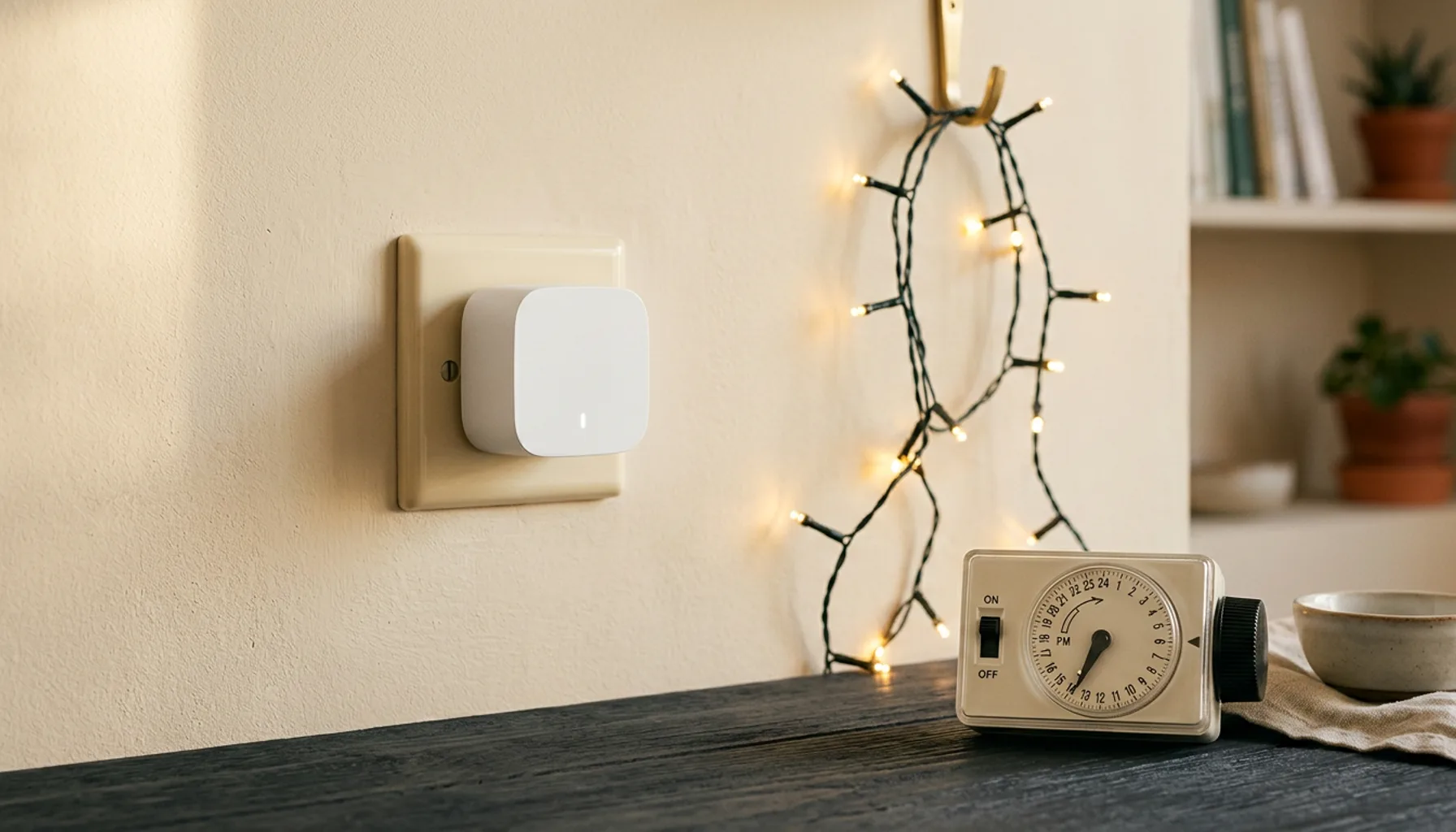
Short answer: if you only want the lights to come on at 17:00 and go off at 23:00, a plug-in timer does that for about £6 and you can stop reading. If you want the lights on at sunset (which in December is before you get home), off when the last person leaves, and a warning when a string quietly dies, buy a Zigbee smart plug — the one we run is the SONOFF S60ZBTPF — and put the string on it. Same socket, same string, one extra device at the end of the chain. The catch is that a Zigbee plug needs something to talk to, so read the coordinator paragraph before you order.
Here’s exactly how the two compare in a real house, what I’d buy for which string, and the three things that go wrong every December.
The setup we actually run
Being straight about what is tested and what is not: we run a 46-device Zigbee network on Zigbee2MQTT with Home Assistant, and the Christmas strings hang off SONOFF S60ZBTPF plugs — the same plugs that switch the dehumidifier in the bathroom and monitor energy the rest of the year. The strings are ordinary supermarket sets with a moulded plug, not “smart” lights.
What that gives us in December: lights on 30 minutes before sunset, off at 23:00 with a random delay so the house doesn’t look like a metronome, an “away” rule that keeps them off entirely when nobody is home, and a notification if a plug is on but reports under 1 W — which is how I found out a string had died instead of noticing three weeks later.
What is not ours: we have not measured twenty timers in a lab. The timer numbers below come from the device categories themselves (mechanical and digital plug-in timers are cheap, dumb and well understood), and the electrical advice comes from the usual UK/EU wiring rules. If your electrician disagrees with me, your electrician wins.
What a plug-in timer really does
A plug-in timer is a socket with a clock in it. Two flavours:
- Mechanical (the dial with pins). Cheap, no battery, survives years on a doorstep. But it drifts: a power cut stops the clock, and in December you will not notice until the lights come on at 15:40. Position accuracy is whatever the pin spacing gives you, typically 15 minutes.
- Digital (the LCD with segments). More accurate, usually keeps time for a few hours on its internal battery, can handle weekday/weekend blocks, and costs maybe twice as much. Still blind: it has no idea what the sun is doing or whether anyone is home.
Both do one job honestly: switch a dumb string on and off on a fixed schedule. Neither reports anything back, so you never learn that a string stopped working.
And there’s the December problem nobody mentions: sunset in the UK moves from about 16:20 in early November to 15:50 at the solstice. A fixed 16:30 timer is right for a week or two and wrong for the rest of the season. You are not going to re-pin the dial every Sunday.
What a smart plug adds
A smart plug is the same socket with a radio and a small computer in it. The version worth buying here is Zigbee, not Wi-Fi, for three practical reasons:
- Local control. No cloud account, no vendor app, no “service discontinued” email in three years. The plug talks to your coordinator, your coordinator talks to Home Assistant.
- Mesh. Mains-powered Zigbee devices also repeat the signal for battery sensors, so a plug in the hallway or the garage is quietly doing two jobs.
- Sun and presence data. Home Assistant knows when sunset is and whether anyone is home, so the schedule is computed, not dialled in.
The S60ZBTPF specifically: Zigbee 3.0, 16 A rated (3,680 W) on the EU listing, energy metering, and it behaves like a normal plug for the family — press the button on the front and the lights come on without a phone. Metering is the underrated part: a string on a plug that reports 0 W is a string with a dead bulb or a blown inline fuse.
Side by side: which one for which job
| Plug-in timer | Zigbee smart plug | Wi-Fi smart plug | |
|---|---|---|---|
| Cost | £5–10 | ~£15–20 + coordinator if you have none | ~£10–15 |
| Needs a hub | No | Yes (Zigbee coordinator) | No, but needs 2.4 GHz Wi-Fi |
| Sunset tracking | No — fixed clock | Yes | Yes, via cloud app |
| Works offline | Yes | Yes (local) | Often no |
| Reports power use | No | Yes | Sometimes |
| Strengthens Zigbee mesh | — | Yes | No |
| Best for | one dumb string, zero setup | anyone already on Home Assistant | a single plug, no hub, cloud fine |
The honest reading of that table: if you have no Zigbee coordinator and no intention of running Home Assistant, a £8 digital timer is the rational buy. A Zigbee plug on its own is a plug with nobody to talk to. The smart plug wins the moment you already have the coordinator — and then it wins clearly, because £15 gives you sunset schedules, presence rules and failure alerts forever instead of a clock that drifts.
How I set it up in Home Assistant
Pairing takes two minutes, and the order matters: pair the plug next to the coordinator, confirm it joins, then move it to its final socket so it settles into the mesh from a good position. Same placement logic as our Zigbee range guide. Rename the entity straight away (switch.christmas_tree_plug) — you will thank yourself in the YAML.
On at sunset, only in season:
automation:
  - alias: "Christmas lights on at sunset"
    triggers:
      - trigger: sun
        event: sunset
        offset: "-00:30:00"
    conditions:
      - condition: template
        value_template: "{{ now().month in [11, 12] }}"
    actions:
      - action: switch.turn_on
        target:
          entity_id: switch.christmas_tree_plug
Off at night, with a random delay so the house doesn’t switch off in unison:
  - alias: "Christmas lights off at night"
    triggers:
      - trigger: time
        at: "23:00:00"
    actions:
      - delay: "{{ range(0, 26) | random }}:00"
      - action: switch.turn_off
        target:
          entity_id: switch.christmas_tree_plug
And the one that earns its keep — a string that died:
  - alias: "Christmas plug on but drawing no power"
    triggers:
      - trigger: state
        entity_id: switch.christmas_tree_plug
        to: "on"
        for: "00:05:00"
    conditions:
      - condition: numeric_state
        entity_id: sensor.christmas_tree_plug_power
        below: 1
    actions:
      - action: notify.persistent_notification
        data:
          message: "Christmas plug is on but pulling under 1 W — bulb, fuse or string."
Add a zone.home condition if you want the away behaviour, or simply put the plug in a group with your “holiday” input boolean and flip it once per season. That’s the whole build. No app, no subscription.
Outdoors: the part where cheap setups fail
Most of the failures I have seen are not software. They are water and load.
- The plug is indoor-only. The S60ZBTPF has no IP rating, so it goes indoors, in a dry socket — and the low-voltage cable goes out through the window frame or the wall, not the other way round. If you need the smart plug itself outside, buy IP44+ hardware and put it in a watertight enclosure on an RCD-protected circuit.
- Transformer bricks go on the plug, not after it. A set that ships with a 12 V or 31 V brick must have the brick on the smart plug. You cannot switch the low-voltage side with a plug.
- Check the load, then stop worrying. LED strings draw a few watts; the plug’s rating (16 A here) is nowhere near the limit. Incandescent or heater-style sets are a different conversation — add up the wattage and keep 20 % headroom.
- Built-in 6/18-hour timers fight you. Plenty of UK sets ship with their own timer that restarts after a power cut. If yours does, set it to “always on” — otherwise your automation and the box in the middle of the cable take turns switching the string.
The honest caveats
- A plug is a switch, not a dimmer. You get on/off. If you want fading, colour or twinkle, that lives in the string or in a dimmable controller, not in the plug.
- Zigbee has a buy-in. Coordinator plus plug is £35–45 if you own neither. A timer is £8. If Home Assistant is not part of your plans, buy the timer and keep the money.
- Wi-Fi plugs are not stupid. They are cheaper and need no hub. What you trade is local control, offline behaviour and mesh — acceptable for one plug, annoying at five.
- Schedules are not magic. A sunset trigger does not know your neighbour’s lights are already up, your kids’ bedtime, or that the council switched the street lamps. Set sensible start/stop times and let it run.
- Verified is not exhaustive. The ASIN we link was live-checked on the EU marketplaces; the same listing appears on amazon.co.uk, .de and .nl. Double-check the seller and variant before ordering.
Bottom line
If you have Home Assistant and a Zigbee coordinator, buy the smart plug: SONOFF S60ZBTPF, one per string, sunset on, 23:00 off, plus the zero-watt alert. That is £15 per string for a schedule that follows the sun and tells you when something breaks. If you have neither a hub nor the appetite for one, an £8 digital timer and a fixed 16:00–23:00 window is genuinely fine — and honest advice beats an upsell. Either way, sort the outdoor side first: the water is what actually kills Christmas lights, not the clock.
Want the full wiring walkthrough and string-by-string buying notes? Our Zigbee Christmas-lights setup guide and the best Zigbee Christmas lights shortlist continue from here.