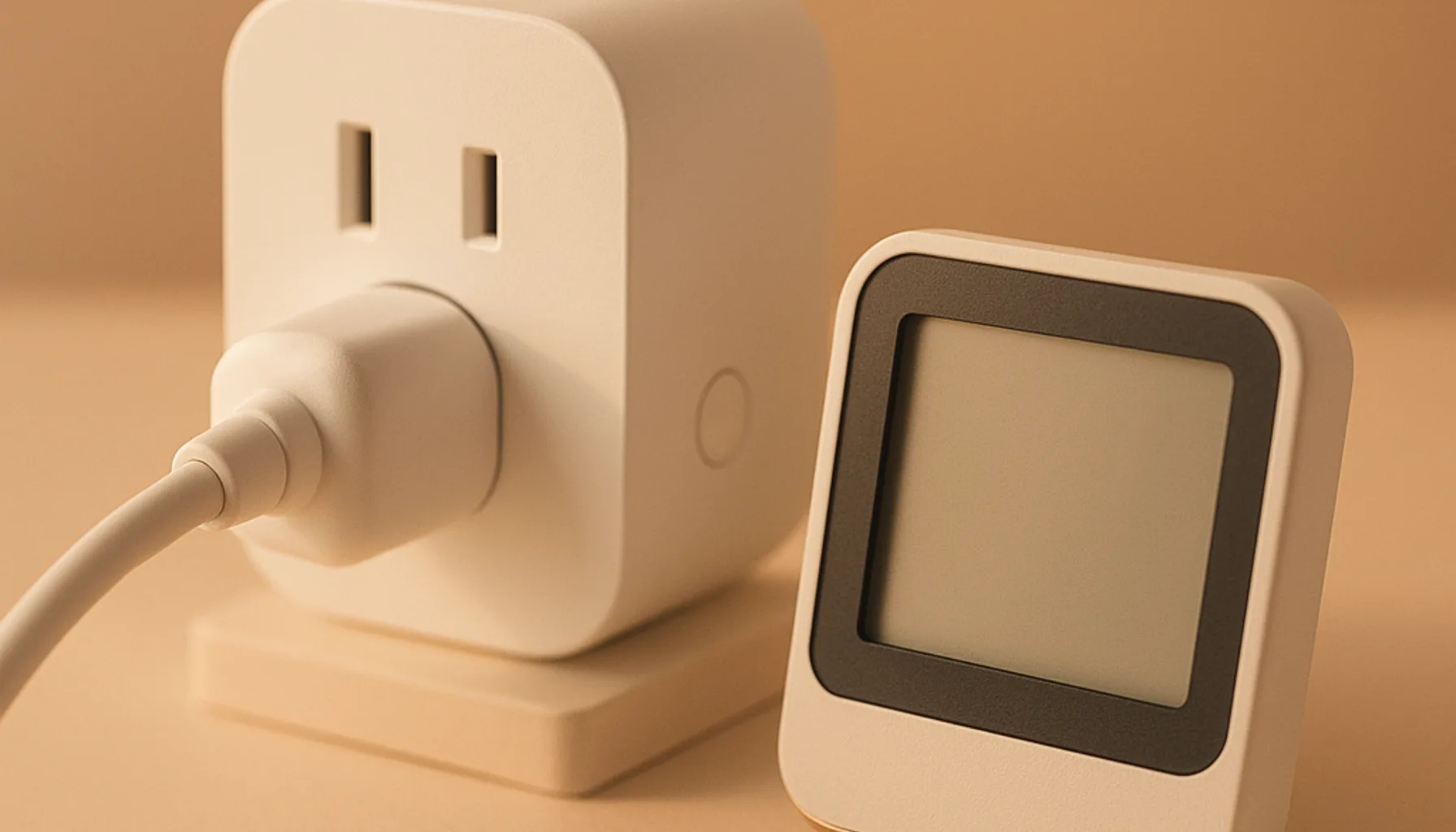
Short answer: put the dehumidifier on a SONOFF S60ZBTPF. It is rated at 16 A, it measures the power the compressor actually draws, and it repeats your Zigbee signal instead of just sitting there. If you also want the room’s humidity in Home Assistant — and you do, otherwise the plug can only switch on a timer — add a SONOFF SNZB-02D. In plain terms: the plug gives you the switch, the sensor gives you the reason to switch.
That is the whole recommendation. The rest of this guide explains why a dehumidifier is not the same as a lamp, so you can check whether your machine fits.
Why a dehumidifier needs a different plug than a lamp
A lamp is a resistive load: it draws a steady current and it does not care how it is switched. A dehumidifier is a small appliance with a compressor motor and often a fan, and motors behave differently. When the compressor starts, the current spikes briefly above the running value. That spike is why cheap plugs with low ratings sometimes click off, or worse, weld their relay shut over a season.
Think of it like this: the label on the plug is a ceiling, not a target. A plug rated at 16 A has plenty of headroom for a machine that runs at 2–3 A. A plug rated at 10 A will usually work too, but you are running closer to the edge for no saving worth having. For a machine that runs for hours in a damp room, buy the headroom.
The one number that matters: amps
Find the rating plate on your dehumidifier — usually on the back, near the power cable. It lists watts or amps. Divide watts by 230 (European mains voltage) and you have the running current. A 400 W machine pulls roughly 1.7 A; the inrush spike is what forces you to round up.
- Under 10 A running: almost any decent Zigbee plug works. Buy for features, not for power.
- 10–13 A running: take a 16 A plug. This is where the S60ZBTPF and the Innr 16 A sit.
- Above 13 A, or a combined heater/dehumidifier: check the manual before you put any smart plug in between. Some manufacturers void the warranty on switched sockets, and that is a decision you make with the manual in hand, not with a product page.
Energy monitoring is the part that pays for itself
Here is the part beginners skip, and it is the reason I would not buy a metering-free plug for this job. A compressor dehumidifier does not run at a constant level: it pulls full power while the compressor is on, then drops to a fraction when the room is dry enough and only the fan runs. Without metering you cannot see that pattern, so you cannot tell whether the machine is cycling properly, whether the room is actually drying, or whether it has been running all night at full power against a door somebody left open.
With power data in Home Assistant you get three useful signals for free: duty cycle (how much of the hour it actually ran), energy per day (what the drying costs you), and a stuck-on alarm (a compressor that never cycles usually means a full tank, a blocked filter, or a broken humidistat).
The shortlist
| Product | Rating | What it brings | Where it fits |
|---|---|---|---|
| SONOFF S60ZBTPF | 16 A | Power metering, Zigbee repeater, compact body | The default pick; one per dehumidifier |
| Innr Indoor Smart Plug | 16 A | Power metering, Hue-compatible, slim | Good alternative, but pack sizes differ per country |
| SONOFF SNZB-02D | — | Temperature and humidity with LCD | The sensor that makes the automation smart |
Note what is not on that list: Wi-Fi plugs. They work, but a dehumidifier usually lives in a bathroom, basement or utility corner — exactly where Wi-Fi is weakest and Zigbee’s mesh earns its keep. Our best smart plug guide covers that trade-off in more detail.
Setting it up in Home Assistant, step by step
- Pair the plug in Zigbee2MQTT or ZHA like any other device. Rename it something you will recognise in six months —
plug_dehumidifier_utility, notplug_3. - Pair the humidity sensor and give it a place that is not directly above the machine’s air outlet, because the exhaust air is drier than the room and will lie to you.
- Turn the machine’s own humidistat to maximum (or continuous) and let Home Assistant decide. Two controllers fighting each other is the classic beginner mistake.
- Build one automation with hysteresis. A starting point: switch on above 65% relative humidity, switch off below 55%. The 10-point gap stops the plug from clicking on and off every few minutes.
- Add a minimum run time and a minimum off time. Most compressor dehumidifiers want a few minutes of rest before restarting; check your manual for the figure and put it in the automation, not in your head.
- Watch the power sensor for a week before you trust the setup. If the compressor never cycles, the automation is not the problem.
What we run, and what we did not test
Our house runs Zigbee2MQTT on a SONOFF ZBDongle-E with 46 devices and Home Assistant doing the automations, and the humidity side of this — sensors, thresholds, dew-point logic — is what we use daily in our own bathroom. The S60ZBTPF is in our own setup as a metering plug on the energy side of the house. The buy-box check for this guide was measured on 27 November 2026 on amazon.co.uk, amazon.de and amazon.nl: all three listings had a normal Add to Cart button.
What we did not do: run a compressor dehumidifier on a smart plug for a full season. So the power figures above are the arithmetic from a rating plate, not a year of logged cycles, and I will not pretend otherwise. If your machine is a desiccant (zeolite) model, it has no compressor, draws a steady current, and everything above about amps becomes much less critical.
Three caveats before you buy
- Tank full. A smart plug cannot see a float switch. If your machine stops when the tank fills, add a water leak sensor next to it or plumb the drain hose — that is the failure nobody plans for.
- Firmware lottery. Metering accuracy varies between Zigbee plug revisions, including within the same model name. Calibrate against a known load once, or at least sanity-check the wattage against the rating plate.
- Don’t automate a fire risk. Never put a dehumidifier on a plug that also feeds a heater, and never in a socket that gets splashed. This is a mains appliance in a wet room; the plug is the least of your electrical decisions.
Verdict
Buy the S60ZBTPF for the amps and the metering, add the SNZB-02D so the plug has something to react to, and keep your automation dumb for the first week: one threshold, one gap, one minimum run time. The clever part of a dehumidifier setup is not the YAML — it is knowing how often the machine actually runs, and that is what a metering plug finally shows you.