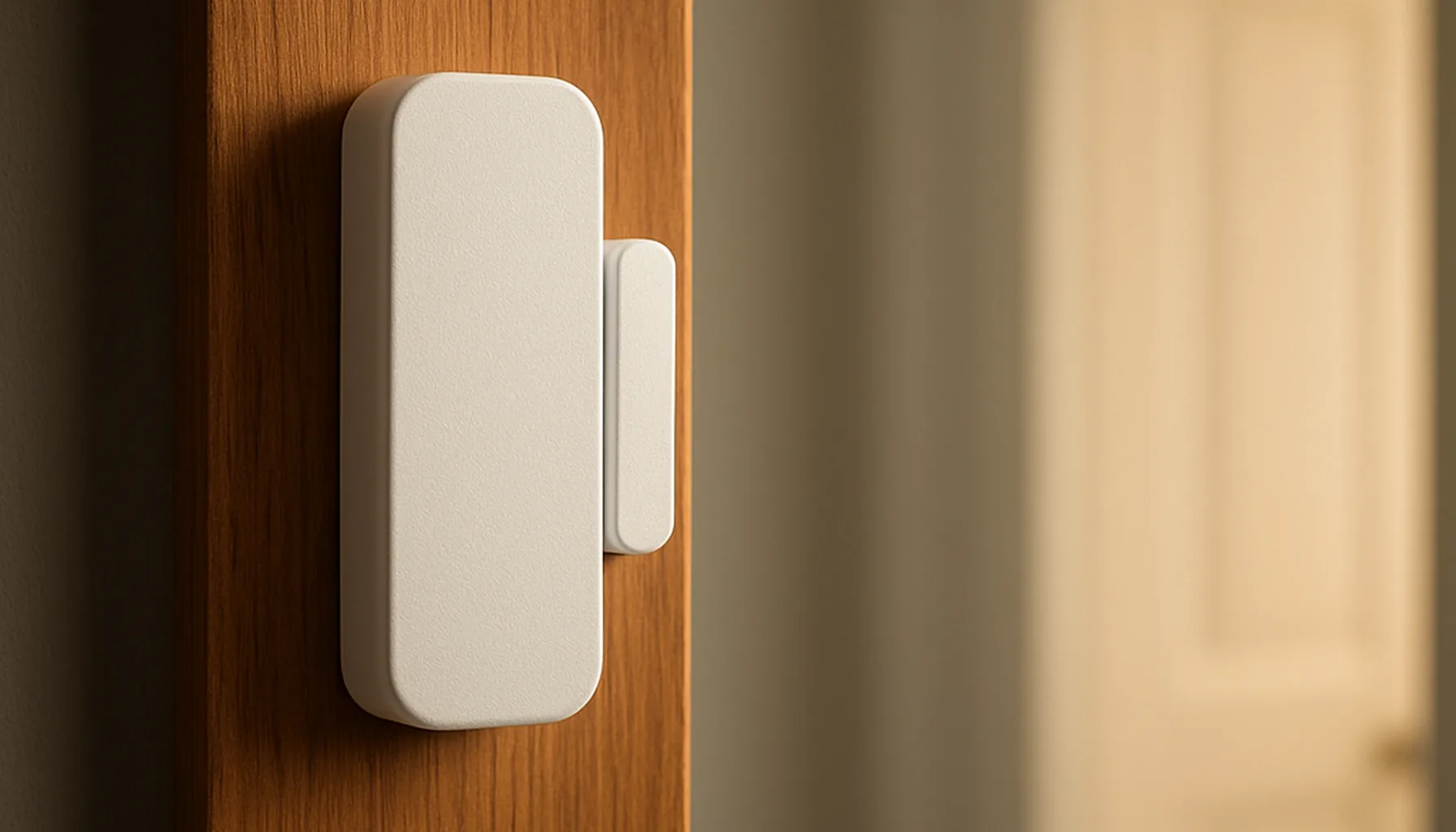
Short answer: For most people in 2026, the Aqara Door and Window Sensor (MCCGQ11LM) is the best Zigbee door/window sensor — tiny, battery-powered, works directly with ZHA and Zigbee2MQTT without a hub, and reliable enough that we trust it for our garage-door monitor. If you want to detect movement or vibration (for example, whether a gate or drawer has been used), the Aqara Vibration Sensor (DJT11LM) is worth adding — with one honest caveat: its sensitivity reviews are mixed.
We run both sensors in our own home, so this comes from a real Zigbee network, not from spec sheets.
What we run
Our garage-door monitor uses an Aqara Door and Window Sensor on the door frame: it reports open/closed instantly over Zigbee to Home Assistant. The same sensor model quietly powers simple automations like “warn if a window stays open” and “remind me to close the back door”.
For movement detection (the “did the gate actually move?” case), we added an Aqara Vibration Sensor. It can also work as a lazy motion sensor on objects where a PIR makes no sense, like a mailbox or a workbench drawer.
Everything runs locally — no cloud account, no hub, no subscription: just the sensors, a Zigbee coordinator, and Home Assistant.
Why the Aqara door sensor (MCCGQ11LM)
- ZHA and Zigbee2MQTT out of the box. No proprietary hub needed; it pairs in seconds and reports state changes immediately.
- Small and elegant. It blends into white and wooden frames; the two parts are held together magnetically, so alignment is forgiving.
- Great battery life. We have units that have run for over a year on the original CR2032 — it only wakes on change, which matters.
- Consistent availability on all three EU marketplaces, usually a genuine Aqara listing at around €12–15 per unit.
The only real complaint people have is that the magnet gap is small — if your door or window frame is very thick, check the alignment before mounting.
When to pick the Aqara vibration sensor (DJT11LM)
The vibration sensor detects vibration, tilt, and drop, so it earns its place for:
- Garage or gate use — did the door physically move? (This is how we detect motion in the garage where a PIR would be useless.)
- Mailbox pings — “mail has arrived” without a camera.
- Drawer/cabinet monitoring — know when something is opened.
Honest caveat: sensitivity adjustment is a real learning curve, and reviews are mixed on how “tunable” it feels. Buy it for the project, not as a guaranteed universal trigger. We use it in the garage-door guide with that nuance.
If you only need open/closed, buy the door sensor. If you need motion, buy the vibration sensor. Very few setups genuinely need both — but a garage-door monitor is one of them.
What we look for
- Local-first: works with ZHA / Zigbee2MQTT, no cloud.
- Fast state changes: the door sensor is effectively instant for open/closed.
- Interoperability: same devices must work whether your stack is ZHA or Zigbee2MQTT.
- Honest pricing: ~€12–15 for a sensor is fair; avoid paying double for “smart home” branding.
Verdict
The Aqara Door and Window Sensor (MCCGQ11LM) is our default recommendation in 2026: cheap, reliable, and it just works with open-source Home Assistant setups. Add the Aqara Vibration Sensor (DJT11LM) only when you specifically need vibration or motion detection on physical objects.
Some links are affiliate links — if you buy through them, we earn a small commission at no extra cost to you. It helps us keep the guides independent and honest.